The fastest way to loosen a stiff mid-back is short, frequent movement in the directions it loses first: rotation and extension. Eight minutes of controlled breathing, rotation and extension drills, done most days, can help your upper back move more freely, and it often takes pressure off a neck and shoulders that have been working overtime.
By Dr. Orr Soffer, DC · Chiropractor in Campbell, CA
If your upper back feels like a plank by Friday afternoon, or you twist to check a blind spot on 17 and feel it all in your neck, this routine is for you. Below you’ll find a two-minute self-test, the exact eight-minute sequence I give patients, and how to tell normal stiffness from something that needs a doctor.
Why Does My Mid-Back Get So Stiff?
Your thoracic spine, the twelve vertebrae between your neck and lower back, is built to rotate and extend. Hours of sitting, driving and screen time keep it in one rounded position, and joints that rarely use their full range feel tight when you finally ask for it.
The Cleveland Clinic lists repetitive strain and posture-related strain among the common causes of upper and middle back pain, along with sprains, strains and age-related changes. Most mid-back stiffness we see is “use it or lose it,” not damage.
The bigger issue is what happens downstream. When the mid-back won’t rotate, the lower back and neck pick up the slack. Your lumbar spine isn’t designed for much twisting, which I explain in what happens to the lumbar spine during rotation. So a stiff upper back can show up as a sore low back after golf or a cranky neck after meetings.
Is Your Mid-Back Actually Stiff? A 2-Minute Self-Test
Run these checks before the routine and again right after. You’re comparing yourself to yourself.
- Seated rotation test. Sit near the front of a chair, feet flat, knees together. Cross your arms over your chest, hands on opposite shoulders. Turn your upper body as far as you comfortably can to the right without letting your knees shift, and note where your breastbone points (a door frame, a lamp). Repeat to the left.
- Wall reach test. Stand with your heels about a foot from a wall, your low back and the back of your head against it. Raise both arms overhead and try to touch the wall with your thumbs without your ribs flaring forward or your low back arching off the wall. If your thumbs stop well short, your mid-back extension and shoulders are likely restricting each other.
If either test causes sharp pain, pins and needles, or symptoms down an arm, skip the routine and read the red-flag section below first.
The 8-Minute Mid-Back Mobility Routine
Move slowly and breathe out during the hardest part of each rep. You should feel stretching and effort, not pinching. Aim for a 0–3 out of 10 on discomfort.
- Cat-cow, mid-back focus (1 minute). On hands and knees, hands under shoulders. Round your upper back toward the ceiling as you exhale, then let your chest sink between your arms as you inhale. Keep your lower back fairly quiet; picture the movement happening between your shoulder blades. 8 slow reps.
- Thread the needle (1.5 minutes). From hands and knees, slide your right arm under your body, palm up, until your right shoulder and ear rest toward the floor. Hold 3 seconds, then reverse and reach that arm up toward the ceiling, following your hand with your eyes. 5 reps per side.
- Open book (2 minutes). Lie on your left side, hips and knees bent to 90 degrees, a pillow under your head, arms straight in front of you, palms together. Keep your knees stacked and sweep your top arm up and over to the other side, letting your chest turn toward the ceiling. Exhale and hold 3 seconds at the end. 6 reps per side.
- Towel-roll extensions (1.5 minutes). Roll a bath towel tightly (or use a foam roller) and lie on it across your mid-back, just below your shoulder blades, knees bent, hands supporting your head. Keep your ribs down and gently extend back over the roll for 2–3 seconds, 3 reps. Move the roll an inch or two higher and repeat, for three spots in total. Never roll or extend over your lower back.
- Wall slides (1 minute). Stand with your back to the wall as in the self-test, elbows bent to 90 degrees and forearms against the wall in a “goalpost.” Slide your arms up as far as you can without your low back leaving the wall, then pull your elbows down toward your back pockets. 8 slow reps.
- Seated rotation with breath (1 minute). Back in your chair, arms crossed. Turn toward your stiffer side, take one full breath at the end of the range, then try to turn a little further on the exhale. 4 reps per side. Then repeat the self-test.
Most people notice an easier turn on the re-test. Over two to four weeks of near-daily practice, the goal is for that new range to stick.
How Often Should You Do It, and What Should You Expect?
Once a day is a good starting dose; twice is fine on heavy desk days. With clocks falling back this weekend, darker evenings mean more couch time, so evenings are a natural slot. If you work from the sofa, pair this with the setup changes in a better evening laptop setup.
| Timeframe | What usually changes |
|---|---|
| Right after one session | Easier rotation on the re-test; the upper back feels warmer and looser |
| Week 1–2 | Less stiffness first thing in the morning and after long meetings |
| Week 3–4 | The range you gained holds longer between sessions; turning to reverse the car feels more natural |
Research on posture exercise is mixed: a systematic review of exercise for age-related rounded upper back posture found the studies too few and too weak to pool, though the better-quality trials pointed toward some benefit. Mobility work helps most alongside strength and better daily habits, not as a posture fix on its own.
Does Mid-Back Mobility Really Help Neck Pain?
There’s reasonable evidence that the mid-back and neck influence each other. A 2019 systematic review and meta-analysis in PLOS ONE found that thoracic spine manipulation improved short-term pain and disability in people with mechanical neck pain compared with mobilization or standard care, though it was no better than neck manipulation or a placebo manipulation. In plain terms: treating the mid-back can help some neck pain, but it isn’t magic.
That’s why we pair hands-on work with home drills like the ones above. If the “tight spot” between your shoulder blades feels more like a knot than a stiff joint, the difference between muscle spasms and muscle knots will help you sort out what you’re dealing with.
How We Treat Mid-Back Stiffness at The ChiropractOrr
We start with an exam that looks at how your whole spine, ribs and shoulders move together, because stiff mid-backs rarely travel alone. From there, care usually follows our Offload → Rebuild → Reeducate approach:
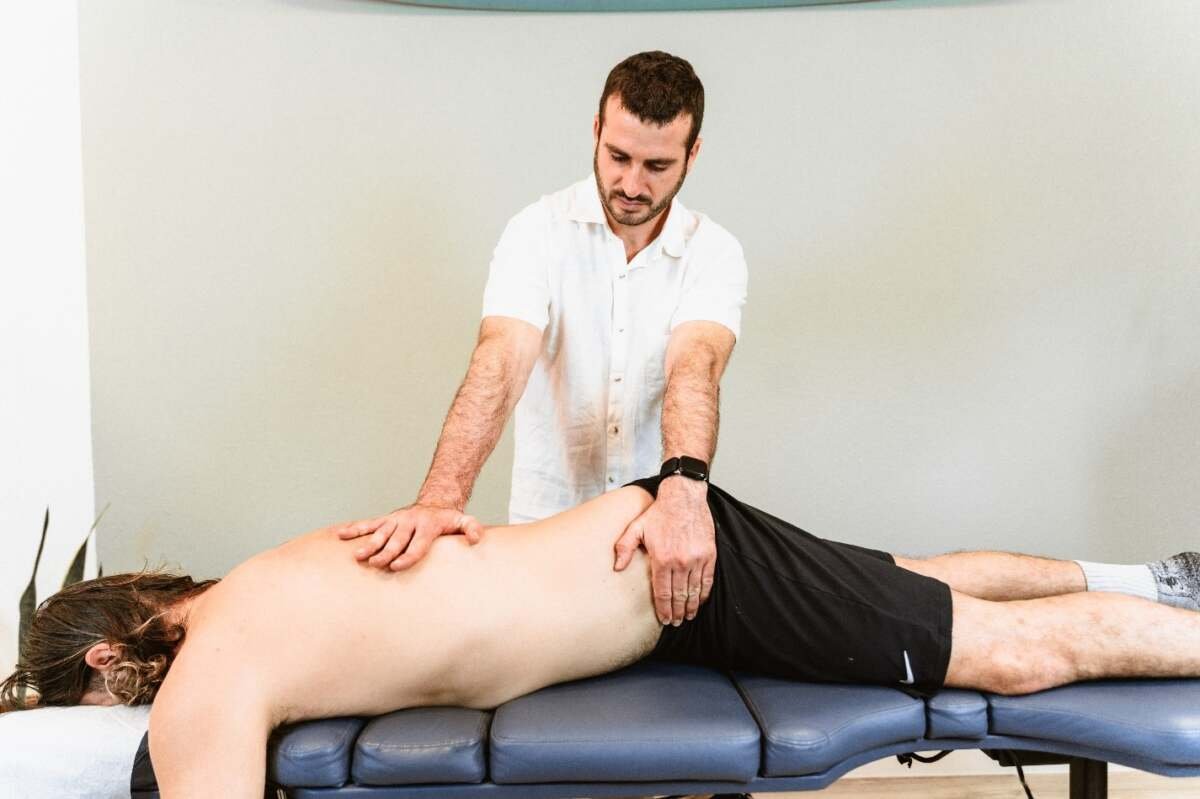
- Offload: a gentle chiropractic adjustment for the mid-back and ribs when it’s appropriate, plus soft tissue work for the muscles between the shoulder blades, to reduce pain and restore motion.
- Rebuild: strength for the muscles that hold that new range, like mid-back extensors and lower traps, through personalized rehab exercise matched to your job and sport.
- Reeducate: practical changes to how you sit, drive and work, and assisted stretching when the chest and shoulders are part of the restriction.
Visits happen in our Campbell clinic, or we can come to you with mobile chiropractic house calls around Los Gatos, Saratoga, San Jose and nearby.
When to See a Doctor First
Mid-back pain is usually mechanical, but organs in the chest and abdomen can refer pain there. Skip the routine and get medical care if you notice:
- Chest pain, shortness of breath, or pain between the shoulder blades with sweating or nausea. Call 911.
- Pain after a fall, car accident or other trauma, especially if you’re older or have osteoporosis.
- Pain that’s worse at rest or at night, or comes with fever or unexplained weight loss.
- Numbness, tingling or weakness in the arms or legs, or any change in bladder or bowel control. Arm symptoms that travel from the neck can point to a pinched nerve in the neck that needs a proper evaluation.
- A history of cancer, or pain that keeps getting worse after a week despite gentle movement.
The Mayo Clinic’s guide on when to see a doctor for back pain covers these warning signs in more detail.
Key Takeaways
- The mid-back loses rotation and extension first, and the neck and lower back often compensate.
- Test before and after: the seated rotation and wall reach checks show you whether the routine is working.
- Eight minutes a day of slow, breath-led drills is enough for most people to notice a change within a few weeks.
- Chest pain, trauma, night pain or arm and leg symptoms mean see a doctor first.
FAQ
How often should I do mid-back mobility exercises?
Once a day is a good starting point, and two short sessions work well on long desk days. Most people notice easier movement within a session or two, and more lasting change after two to four weeks.
Is it normal for my upper back to pop during these stretches?
Yes, an occasional painless pop during rotation or extension is common and usually just gas releasing from a joint. You don’t need to chase it. If a pop comes with sharp pain, lingering soreness or nerve symptoms, stop and get it checked.
Can a stiff mid-back cause neck and shoulder pain?
It can contribute. When the mid-back doesn’t rotate or extend well, the neck and shoulders often do extra work, especially when reaching overhead or turning your head. Research suggests treating the mid-back can help some types of neck pain in the short term.
Should I foam roll my lower back too?
No. Keep the foam roller or towel on the mid-back, between the bottom of your shoulder blades and the base of your neck, where the ribs support the spine. For the lower back, gentle movement and strengthening are a better choice than rolling.
If your mid-back still feels stuck after a few weeks of this routine, or you’d like a plan built around your desk, sport and history, book your initial evaluation or call (408) 641-0739. Can’t make it to Campbell? Mobile visits bring the same care to your home or office.
Written by Dr. Orr Soffer, DC, chiropractor at The ChiropractOrr in Campbell, CA. This article is educational and not a substitute for an individual medical evaluation.