Most aches on the Los Gatos Creek Trail come from five places: the front of the knee, the outside of the knee (IT band), the Achilles, the heel, and the shins. Nearly all of them are overuse problems, which means they usually respond to smarter loading and targeted strength work rather than weeks on the couch.
By Dr. Orr Soffer, DC · Chiropractor in Campbell, CA
If you run the trail between Vasona Lake and downtown Campbell a few times a week and something has started nagging you, this guide will help you figure out which ache it probably is, what usually drives it, and a five-minute self-check you can do at home tonight.
Why do so many trail runners get hurt in the first place?
Running injuries are mostly a load problem. A review in American Family Physician notes that about 80% of running injuries are due to overuse, most often at the knee, hamstring, shin, ankle or plantar fascia. The same review reports one-year injury rates of 27% in novice runners and 52% in marathon runners.
The trail itself makes overloading easy. It is paved from downtown Los Gatos north through Campbell, so it’s tempting to stack miles at a steady pace. South of town, the unpaved section toward Lexington Reservoir adds a steady climb and a long descent on the way back. Add the clocks falling back this weekend, which pushes many after-work runs into the dark and onto the weekend, and a lot of people end up squeezing the week’s miles into one big Saturday loop. That is exactly the pattern research flags.
A 2025 study of 5,205 runners, summarized by the British Journal of Sports Medicine, found that injury risk was tied to single-session spikes. Runs more than 10–30% longer than the longest run in the previous 30 days carried a 64% higher injury rate than runs within 10%.
Which aches do we see most from Campbell runners?
Use this as a rough map, not a diagnosis.
| Where it hurts | Likely culprit | Typical pattern |
|---|---|---|
| Front of the knee, around the kneecap | Runner’s knee (patellofemoral pain) | Worse on stairs, squatting, downhills, or after sitting with knees bent |
| Outside of the knee | IT band syndrome | Starts at a predictable mile, sharpens on descents, eases at rest |
| Back of the ankle, above the heel | Achilles tendinopathy | Stiff for the first steps of the day, warms up, aches again later |
| Bottom of the heel | Plantar fascia irritation | Sharp first steps out of bed or after sitting |
| Inner edge of the shin | Shin splints (medial tibial stress syndrome) | Diffuse tenderness along the bone, common after a sudden mileage jump |
Runner’s knee
This is a dull ache around or behind the kneecap. Mayo Clinic lists pain on stairs, with squatting, and after long periods of sitting with bent knees as hallmark signs. Weak hip and thigh muscles are a common contributor, which is why we look well above the knee. If you’ve already wondered whether hands-on care helps, our piece on chiropractic care for knee pain covers what it can and can’t do.
IT band pain
The IT band itself doesn’t stretch much. Pain on the outside of the knee usually reflects how well your hip controls the knee mile after mile. Hip-abductor strengthening is a core part of the plan, and opening up stiff hips helps too. These hip mobility stretches for active adults are a good start.
Achilles and heel pain
These two often travel together, especially in runners who added hills or switched shoes. Both are load-sensitive tissues that tend to improve with progressive strengthening rather than rest. Limited ankle bend is a frequent driver, so our 10-minute ankle mobility routine pairs well with calf work.
Shin splints
Shin splints are tenderness spread along the inner shin, usually after a jump in mileage. Pain that sits in one small, very tender spot is a different story (see the red flags below).
What’s a quick self-check you can do tonight?
You need a step, a chair and a mirror. The goal is to compare sides, not to pass a test.
- Single-leg calf raises. Stand on one foot on the edge of a step, holding a rail lightly. Rise all the way up and lower slowly, counting reps until you can’t get full height. Repeat on the other leg. A clear gap between sides is worth working on, especially if you have Achilles or heel pain.
- Single-leg sit-to-stand. Facing a mirror, sit down onto a chair on one leg and stand back up, 5 reps per side. Watch your knee: does it drift inward or does your pelvis drop? That pattern often shows up in runner’s knee and IT band pain.
- Side plank hold. On your forearm with knees straight (or bent, to make it easier), hold up to 30 seconds per side. If one side fails much sooner, your hip stabilizers are a likely target.
- Knee-to-wall ankle test. In a half-kneeling lunge facing a wall, slide your front knee toward the wall without lifting the heel. Compare how far your toes can be from the wall on each side.
- Your long-run check. Open your watch app and find your longest run in the last 30 days. Keep this weekend’s long run within about 10% of that number.
If one side lags, a simple starting plan is 3 sets of 10–15 slow calf raises, 3 sets of 8 single-leg sit-to-stands and 3 side-plank holds per side, three days a week. Give it four to six weeks before judging the results. If you want this built around your specific findings, that’s exactly what personalized rehab exercise is for.
Do you have to stop running?
Usually not completely. A practical rule many runners use: pain during a run should stay mild (around 3 out of 10 or less) and be no worse the next morning. If it is, you’ve found a load you can keep while you rebuild. Swap hills and speed work for flat, easy miles, shorten the long run, and keep the strength work going.
That fits how we think about recovery here: Offload (cut the load that’s provoking it, without stopping everything), Rebuild (strengthen the calf, hip and thigh so they can handle more), and Reeducate (work back up to normal mileage and form with a plan instead of a guess).
How We Treat Running Aches at The ChiropractOrr
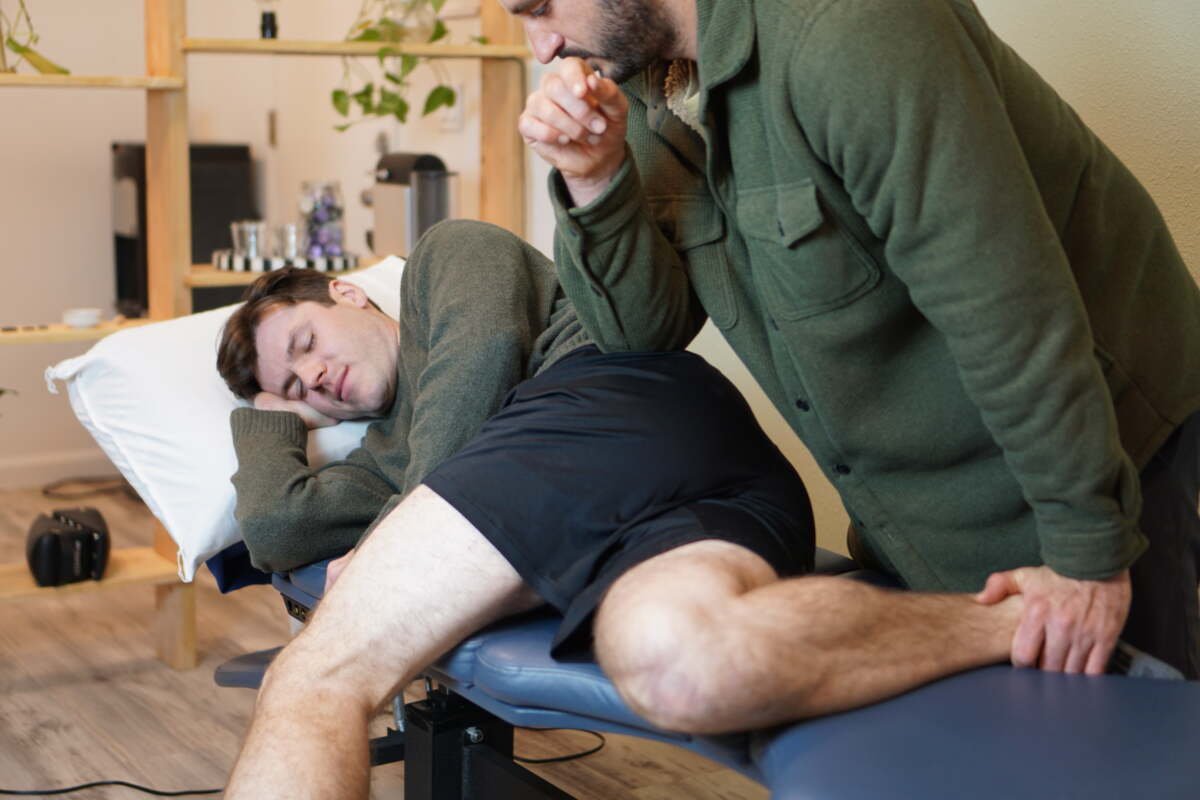
Your first visit starts with a conversation about your mileage, recent changes and where it hurts, followed by an exam of your hips, knees, ankles and feet. We look at how you squat, lunge, balance and load on one leg, because that is usually where the cause shows up.
Treatment typically combines targeted soft tissue therapy for irritated calves, quads and hip muscles, joint work where stiffness is limiting motion, and assisted stretching. For stubborn Achilles or heel pain, focused shockwave therapy may be an option, and our article on shockwave for sports injuries explains when we consider it. Every visit ends with exercises you take home, progressed as you improve.
We see runners in our Campbell clinic and through mobile chiropractic visits at home in Los Gatos, Saratoga, San Jose and nearby.
When to See a Doctor First
Skip the self-check and get a medical evaluation if you notice:
- Pain in one small spot on a bone (shin, foot or hip) that hurts to press, hurts while walking, or hurts at night, which can signal a stress fracture
- A sudden pop or kick-like feeling at the back of the ankle, or trouble rising onto your toes
- A knee that swells quickly, locks, or gives way
- Numbness, tingling, or a calf that is hot, red and swollen
- Fever, or pain that keeps getting worse despite cutting back
For chest pain, trouble breathing, or signs of a stroke during or after a run, call 911.
Key Takeaways
- Most trail-running aches are overuse injuries at the knee, Achilles, heel or shin.
- One oversized run is a bigger risk than a slightly bigger week, so keep long runs within about 10% of your recent longest.
- Pain that stays mild and settles by morning usually means you can keep running while you rebuild.
- Calf, hip and thigh strength do more for most runners than stretching alone.
- Pinpoint bone pain, a pop at the Achilles, or a swollen, locking knee needs a doctor first.
FAQ
Is it OK to keep running with runner’s knee?
Often, yes, if you shorten runs and stay at a level where pain stays mild (around 3 out of 10 or less) and settles by the next morning. Flat, paved stretches are usually easier than hills or stairs. If pain climbs during the run or you start limping, stop and get it checked.
Why does my IT band hurt only after a few miles?
IT band pain tends to build with repeated knee bending under load, so it often shows up at a predictable point in a run and then gets sharper. Downhills and the camber of a path can make it worse. Strengthening the hip muscles that control your knee usually matters more than stretching the band itself.
Should I ice or rest an Achilles that hurts in the morning?
Full rest tends to make tendons less tolerant of load, not more. Most runners do better reducing speed work and hills while adding slow calf-strengthening exercises. If the tendon is swollen, very tender to squeeze, or you felt a sudden pop, see a doctor before doing anything else.
How much can I increase my long run without getting hurt?
A large study of over 5,000 runners found that injury risk rose when a single run was more than about 10% longer than the longest run in the previous 30 days. So plan long-run increases in small steps, and don’t add a big bonus loop just because you feel good that day.
Can a chiropractor help with running injuries?
A chiropractor who works with runners can assess how your hips, knees, ankles and feet are moving, treat stiff joints and irritated soft tissue, and build a strength plan to get you back to your usual mileage. The hands-on work helps calm things down, and the exercise is what makes the change last.
If an ache is starting to change how you run, we’d be glad to take a look. Book your initial evaluation or call (408) 641-0739. If it’s hard to get away, mobile visits bring the same assessment to your home.
Written by Dr. Orr Soffer, DC, chiropractor at The ChiropractOrr in Campbell, CA. This article is educational and not a substitute for an individual medical evaluation.