Tennis and pickleball elbow usually improves best when you keep using the arm but change how much load the tendon gets: a short break from painful grip, then progressive strengthening of the forearm extensors, plus fixes to grip and stroke. Rest alone tends to bring the pain back the moment you return to the court.
By Dr. Orr Soffer, DC · Chiropractor in Campbell, CA
If the outside of your elbow aches when you pick up a coffee mug, shake hands or hit a backhand dink, this is for you. Below you’ll find a quick self-check, a four-step loading routine you can start today, and an honest look at when hands-on care or shockwave makes sense.
What is pickleball elbow, really?
“Pickleball elbow” and “tennis elbow” are the same problem: lateral elbow tendinopathy, an overloaded tendon where the wrist and finger extensor muscles attach to the outside of the elbow. Despite the name, Cleveland Clinic notes that more than 9 in 10 people develop it for reasons other than tennis. Keyboards, tools, lifting kids and gardening all load the same tendon.
Pickleball adds a few specific stresses. The paddle is solid, so there’s less give than a strung racquet. Play at the kitchen line is full of quick wrist flicks and blocked volleys. And because the game is easy to pick up, plenty of people go from zero to five games a day within a few weeks. The tendon simply hasn’t had time to adapt to that volume.
The key word is tendinopathy, not “inflammation.” In most cases that last more than a few weeks, the tendon has a capacity problem: it can’t tolerate the load you’re asking of it. That’s why rest feels good but doesn’t fix it, and why the plan below focuses on building capacity back up.
How can you tell if it’s tennis elbow?
Try this two-minute self-check. It isn’t a diagnosis, but it helps you decide whether the routine below is a reasonable place to start.
- Find the spot. Press on the bony bump on the outside of your elbow, then about a thumb’s width below it toward the forearm. Tennis elbow is usually tender right there.
- The coffee-mug test. Lift a full mug or a 1–2 lb object with your palm facing down. Then lift it with your palm facing up. Pain with palm-down, much less with palm-up, points toward the extensor tendon.
- Resisted wrist extension. Rest your forearm on a table, palm down. Lift the back of your hand while your other hand pushes down on it. Pain at the outer elbow is a typical sign.
- Rate it. Note your pain from 0–10 on the mug test. Repeat it once a week to track progress.
If you also have neck pain, tingling into the hand, or the pain spreads widely down the arm, the elbow may not be the only source. Nerve irritation from the neck can mimic elbow pain; our guide to pinched nerves in the neck explains how that feels.
What helps tennis elbow heal? A 4-step loading routine
The 2022 JOSPT clinical practice guideline on lateral elbow pain recommends isometric, concentric and eccentric strengthening of the wrist extensors for subacute and chronic cases. Here’s how we turn that into something you can do at home with a light dumbbell or a full water bottle.
The pain rule: mild discomfort up to about 3/10 during exercise is acceptable, as long as it settles by the next morning. If it’s worse the next day, drop the weight or the reps.
- Isometric wrist extension (start here if it’s irritable). Forearm on a table, palm down, hand off the edge holding a light weight. Hold the wrist level, without moving, for 30–45 seconds. Rest 1 minute. Do 5 holds, once or twice a day. Many people notice the elbow feels calmer right after.
- Slow wrist extension. Same position. Lift the hand up over 2–3 seconds, lower over 3–4 seconds. 3 sets of 15, every other day. When the last few reps feel easy, add a little weight.
- Forearm rotation with a hammer. Hold a hammer near the head, elbow bent at your side. Slowly rotate palm-up to palm-down and back. 3 sets of 10–15 each way. Move your hand farther down the handle to make it harder.
- Band rows for the shoulder blade. Anchor a band at chest height and pull your elbows back, squeezing the shoulder blades together. 3 sets of 12–15. A stronger shoulder and upper back means the forearm does less of the work on every swing.
Give it 6–8 weeks of consistent work before judging it. Tendons adapt slowly, and the first two weeks are mostly about calming things down. Our personalized rehab exercise programs progress this based on how your elbow responds.
What changes on the court help most?
Strength work fixes capacity. Court habits reduce how much load you pile on while that capacity builds.
- Loosen your grip. On a 1–10 scale, aim for about 4 between shots, firming up only at contact. A death grip keeps the extensors working the whole rally.
- Check your grip size. A handle that’s too thin makes you squeeze harder. An overgrip is an easy, cheap fix.
- Use your body, not your wrist. Turn your shoulders and hips into drives. Wrist-flick dinks and roll volleys load the tendon most.
- Try a two-handed backhand while you’re symptomatic. It shares the load with the other arm.
- Manage volume. If you jumped from twice a week to daily, scale back to a level where the elbow settles overnight, then build up again.
- Consider a counterforce strap. The JOSPT guideline supports it only for short-term relief during play. Our post on whether kinesiology tape works covers taping options too.
Same ideas apply off the court: a lighter mouse grip, lifting bags palm-up, and breaking up long sessions of tool use.
Is a cortisone shot or shockwave the better option?
Cortisone injections can quiet pain quickly, but Cleveland Clinic notes they may not help when symptoms have lasted longer than six weeks. Because the underlying issue is tendon capacity, short-term relief without strengthening often means the pain returns.
Focused shockwave delivers acoustic pulses to the tendon to stimulate a healing response. An August 2025 umbrella review in the Journal of Orthopaedics and Traumatology found that shockwave reduced pain in lateral epicondylitis more than ultrasound or corticosteroid injections. That’s encouraging, but studies use different devices and protocols, and shockwave works best as part of a loading program, not a replacement for it. If you’re curious what a session involves, read what to expect during your first PiezoWave shockwave session.
Surgery is rarely needed and is generally considered only after months of well-run conservative care.
How We Treat Tennis and Pickleball Elbow at The ChiropractOrr
We follow a simple framework: Offload → Rebuild → Reeducate. The first visit is a full exam of the elbow, wrist, shoulder and neck, because the elbow is often the place that hurts rather than the only place that’s struggling.
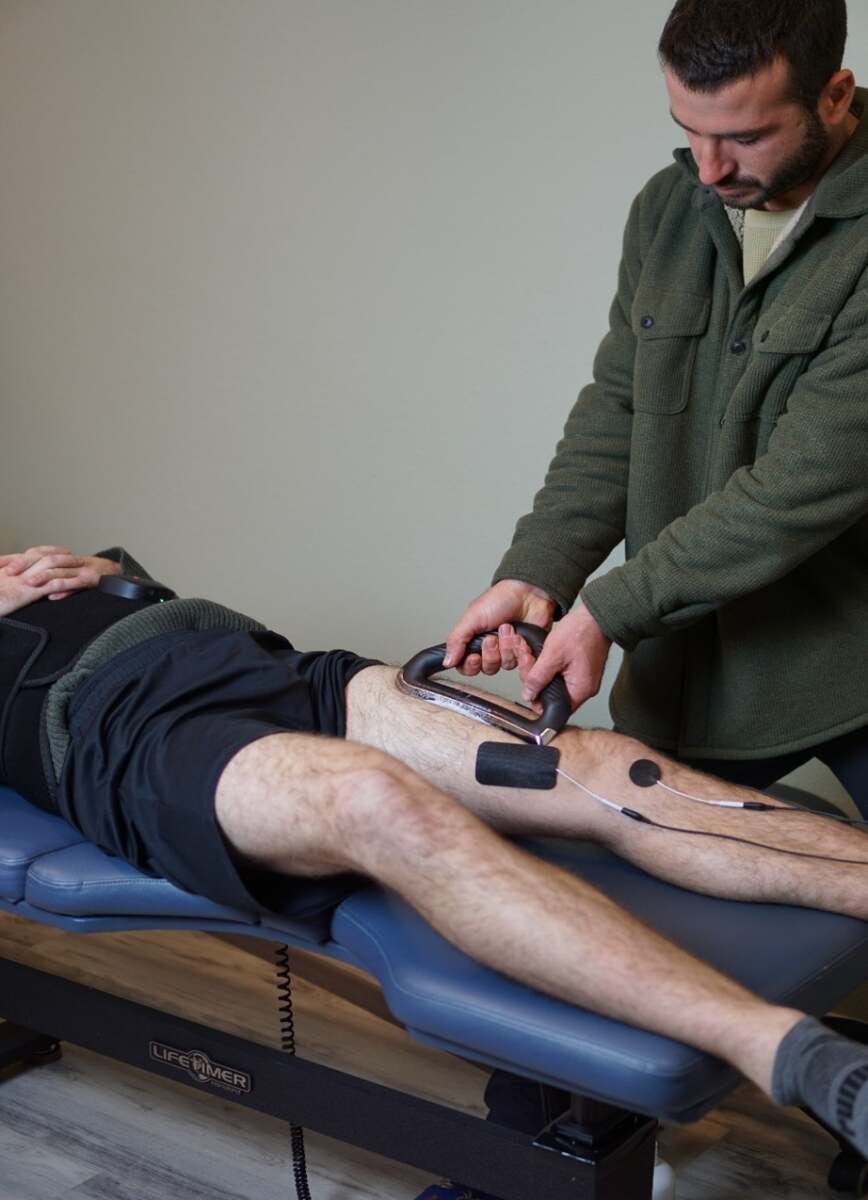
- Offload: We adjust your playing volume and grip, use elbow joint mobilization, and treat tight forearm tissue with FAKTR soft tissue therapy, which works on the tissue while you move. The JOSPT guideline supports local elbow manual therapy for pain and grip strength.
- Rebuild: A progressive strength plan like the one above, adjusted every visit. For stubborn cases lasting months, focused shockwave therapy with the PiezoWave2T can be added to support tendon healing.
- Reeducate: We look at your swing, grip and shoulder mechanics so the load spreads through the whole chain. Dr. Orr is a former national-team sailor, so grip-heavy sports are familiar territory.
Athletes who want the bigger picture can read how we use shockwave therapy for sports injuries. We see patients in-clinic in Campbell, and mobile chiropractic visits are available across Los Gatos, Saratoga, Cupertino and San Jose.
When to See a Doctor First
Get a medical evaluation before starting a home program if you notice:
- A fall or blow to the elbow followed by swelling, bruising, deformity or inability to straighten or bend it
- A hot, red, swollen elbow, especially with fever
- Numbness or tingling in the ring and little fingers, or weakness in the hand
- Pain that is constant at rest or at night and not linked to use
- The elbow locking or catching
- Arm symptoms together with chest pain, shortness of breath or sudden weakness. Call 911.
Key Takeaways
- Pickleball elbow is lateral elbow tendinopathy, a load-capacity problem rather than simple inflammation.
- Progressive wrist-extensor strengthening is the backbone of recovery, starting with isometric holds if it’s irritable.
- A looser grip, the right handle size, more body rotation and smarter volume reduce strain while you rebuild.
- Shockwave can help stubborn cases, best combined with strengthening.
- Expect gradual change over weeks to months, not overnight.
FAQ
How long does tennis or pickleball elbow take to heal?
It varies a lot. Cleveland Clinic notes recovery usually takes around six months, and some people need up to 18 months. A structured loading program and smarter court habits tend to shorten the stubborn middle phase, while repeated flare-ups from playing through sharp pain tend to lengthen it.
Should I stop playing pickleball with tennis elbow?
Not always. If pain during play stays at about 3 out of 10 or lower and settles by the next morning, many people can keep playing with fewer games, a looser grip and a two-handed backhand. If pain is sharp, builds during play or lingers into the next day, cut back until your strength work is moving in the right direction.
Does a tennis elbow brace work?
A counterforce strap can make playing more comfortable in the short term for some people. The 2022 JOSPT guideline supports it only for immediate relief during aggravating activity, not as a long-term fix, so use it alongside strengthening rather than instead of it.
Is shockwave therapy good for tennis elbow?
Research suggests it can help, especially for symptoms that have lasted months. A 2025 umbrella review found shockwave reduced pain more than ultrasound or corticosteroid injections. It works best combined with progressive strengthening, and it is not the right fit for everyone, so an exam comes first.
If your elbow is keeping you off the court, we’d be glad to take a look. Book your initial evaluation or call (408) 641-0739. Can’t make it to Campbell? Ask about a mobile visit.
Written by Dr. Orr Soffer, DC, chiropractor at The ChiropractOrr in Campbell, CA. This article is educational and not a substitute for an individual medical evaluation.