Frozen shoulder (adhesive capsulitis) moves through three stages: a painful freezing stage, a stiff frozen stage, and a gradual thawing stage. What helps changes with each one. Early on, calm the pain and keep the joint moving gently. Later, stretch harder and rebuild strength.
By Dr. Orr Soffer, DC · Chiropractor in Campbell, CA
If you can’t reach the top shelf or tuck in a shirt anymore, and the shoulder aches at night for no obvious reason, this guide is for you. You’ll get a quick self-check to find your stage and an exercise plan you can start today.
What Is Frozen Shoulder, and Who Gets It?
The shoulder joint sits inside a capsule of connective tissue. In frozen shoulder, that capsule becomes inflamed, then thickens and tightens, so the ball has less room to move. The result is pain plus stiffness in almost every direction, especially turning the arm out and reaching up behind your back.
According to Mayo Clinic, it is more common in people 40 and older, especially women, and in people with diabetes, thyroid disease, cardiovascular disease or Parkinson’s disease. A period of immobility, such as wearing a sling after a broken arm or surgery, also raises the risk.
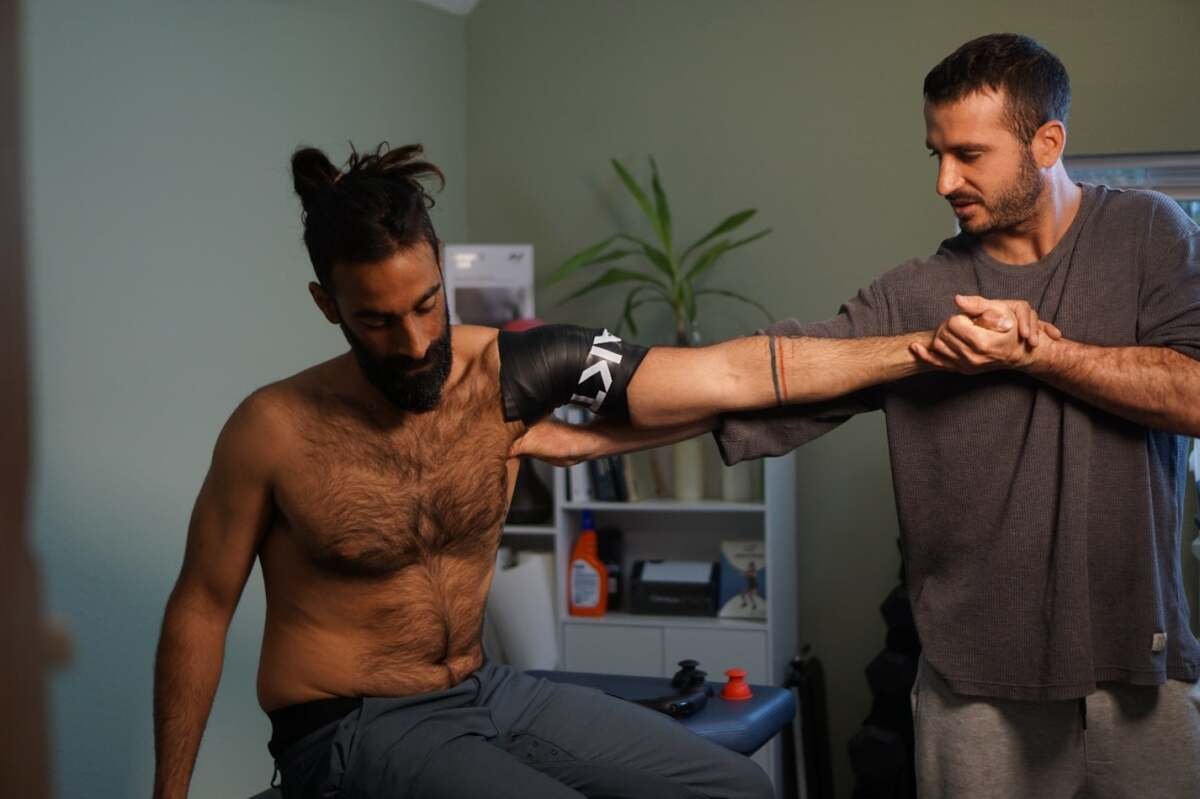
Frozen shoulder is often confused with rotator cuff problems. The quick difference: with rotator cuff impingement, someone else can usually lift your arm higher than you can on your own. With frozen shoulder, as the American Academy of Orthopaedic Surgeons explains, motion is limited both when you move and when someone moves the arm for you, because the capsule itself is tight.
What Are the Three Stages of Frozen Shoulder?
Timelines vary widely, and the stages blend rather than switch overnight. Mayo Clinic describes recovery as typically taking one to three years overall.
| Stage | What you notice | Main goal |
|---|---|---|
| 1. Freezing | Pain is the headline. Night pain, sharp twinges with quick movements, motion slowly shrinking. | Calm pain, protect sleep, keep gentle pain-free motion. |
| 2. Frozen | Pain eases, but the shoulder feels stuck. Daily tasks are limited by stiffness more than pain. | Stretch into mild tension, restore motion, keep the shoulder blade and upper back moving. |
| 3. Thawing | Motion slowly returns. Some weakness and guarding remain. | Rebuild strength and control through the new range so it sticks. |
The most common mistake we see is treating stage 1 like stage 2: forcing hard stretches into a hot, irritable shoulder. That usually leads to a bigger flare that night and more guarding the next day.
Which Stage Am I In? A 2-Minute Irritability Self-Check
Physical therapy guidelines published in the Journal of Orthopaedic & Sports Physical Therapy recommend matching stretching intensity to how irritable the tissue is, not to the calendar. You can get a rough read on irritability at home. Answer these four questions:
- Night pain: Does the shoulder wake you most nights, or make it hard to lie on that side?
- Where pain starts: Lift your arm slowly forward. Does pain start well before you hit stiffness, or only at the end where it feels tight?
- Rest pain: Does it ache even when the arm is resting by your side?
- After-effects: After gentle exercise, does pain stay worse for more than an hour or into the next morning?
Mostly “yes”: high irritability, which usually lines up with the freezing stage. Mixed: moderate irritability. Mostly “no,” and you’re limited by tightness rather than pain: low irritability, typical of the frozen and thawing stages. Re-check every two weeks, because the answer will change.
What Helps in the Freezing Stage?
The job here is to calm things down without letting the shoulder sit completely still. Keep every movement in the comfortable range. Mild awareness is fine; sharp pain is not.
- Pendulums: Lean on a table with your good arm and let the sore arm hang. Shift your body weight so the arm drifts in small circles. 1 to 2 minutes, 2 to 3 times a day.
- Table slides: Sit with your forearm on a towel on a table. Slide the arm forward by leaning your trunk forward, then return. 10 slow reps.
- Supported external rotation: Lying on your back, elbow tucked at your side, use a stick held in the other hand to rotate the forearm outward only as far as it stays comfortable. 10 reps with a 3-second pause.
- Gentle isometrics: Press the back of your wrist lightly into a wall (outward), then the palm (inward), at about 20 percent effort. Hold 10 seconds, 5 times each.
For sleep, try lying on your back with a pillow under the elbow, or on the good side hugging a pillow. The JOSPT guideline also notes that a corticosteroid injection combined with exercise can improve short-term pain and function, which is a conversation for your physician.
What Helps in the Frozen and Thawing Stages?
Once pain at rest and at night has settled, the shoulder can handle more. Stretches should now go into a firm, tolerable pull, about 4 to 5 out of 10, and the soreness should fade within an hour.
- Stick external rotation stretch: Same position as before, but hold at the point of tension for 30 seconds. 3 to 4 reps, once or twice daily.
- Wall walk or supine stick flexion: Walk your fingers up a wall, or lie down and use both hands on a stick to take the arm overhead. Hold 30 seconds at the top, 3 to 4 reps.
- Towel behind the back: Hold a towel over your good shoulder with the good hand and grab the bottom end with the sore hand behind your back. Pull gently upward. 30 seconds, 3 reps.
- Cross-body stretch: Bring the sore arm across your chest and ease it closer with the other hand. 30 seconds, 3 reps.
As range returns in the thawing stage, add strength so the shoulder can actually use it: band rows and band external rotation (2 to 3 sets of 12 to 15), and wall slides with a light band around the wrists (2 sets of 10). Don’t forget the rest of the chain. A stiff upper back limits overhead reach, so pairing your shoulder work with a short mid-back mobility routine is worth the extra five minutes.
How We Treat Frozen Shoulder at The ChiropractOrr
Every plan starts with an exam to confirm it’s actually frozen shoulder and not a cuff tear, arthritis, or pain referred from the neck. If you’re curious how a first appointment runs, here’s what to expect at your first chiropractic visit. From there, we follow our Offload → Rebuild → Reeducate framework and match it to your irritability level:
- Offload: In the painful stage, low-force joint mobilization within the pain-free range, gentle soft tissue therapy around the shoulder and shoulder blade, and sleep and activity tweaks. No forcing.
- Rebuild: As irritability drops, mobilization moves progressively into the stiff range. We add chiropractic adjustments for the upper back and ribs when they help overhead motion, plus assisted stretching.
- Reeducate: A personalized rehab exercise plan that progresses each week, so your gains hold up in daily life, at the gym, or on a surfboard.
Frozen shoulder is slow, and we’ll be honest about that. Good care aims to improve sleep, daily function and the motion you keep along the way. We work alongside your physician if imaging or an injection makes sense. Visits are in-clinic in Campbell, or through mobile chiropractic house calls if driving is hard right now.
When to See a Doctor First
Get a medical evaluation before starting any exercise plan if you have:
- Shoulder or arm pain with chest pain, shortness of breath, sweating or jaw pain. Call 911.
- Sudden inability to lift the arm after a fall or a heavy pull, which can signal a rotator cuff tear or dislocation.
- Fever, a hot red swollen joint, or feeling unwell, which can signal infection.
- Numbness, tingling or weakness running down the arm. This can come from the neck, as in cervical radiculopathy.
- Unexplained weight loss, a history of cancer, or constant pain that doesn’t change with position.
- Diabetes or thyroid disease that isn’t well controlled. Your doctor can help with that part of recovery.
Key Takeaways
- Frozen shoulder moves through freezing, frozen and thawing stages, and recovery typically takes one to three years.
- Match exercise intensity to irritability, not the calendar: gentle and pain-free when it’s hot, firmer stretching when stiffness dominates.
- Pendulums, table slides and supported rotation suit the painful stage; 30-second stretches and band strengthening suit the later stages.
- Upper back mobility and shoulder blade strength make overhead reach easier.
- Rule out red flags first, and re-check your irritability every two weeks.
FAQ
How long does frozen shoulder last?
Most cases improve gradually over one to three years, according to Mayo Clinic. The painful freezing stage usually gives way to a stiff frozen stage, then a slow thawing stage. Staying active within comfortable limits and progressing your exercises as pain settles can make each stage easier to live with.
Should I stretch a frozen shoulder if it hurts?
It depends on how irritable the shoulder is. In the early, painful stage, gentle pain-free movement usually works better than hard stretching, which can flare it up. Once pain settles and stiffness is the main problem, firmer stretches held into mild tension become more useful.
Can a chiropractor help frozen shoulder?
A chiropractor can help with stage-appropriate joint mobilization, soft tissue work around the shoulder and upper back, and a guided exercise plan. Care should be gentle and matched to how irritable the joint is, and it works alongside your medical doctor if you need imaging or an injection.
Is frozen shoulder the same as a rotator cuff problem?
No. With a rotator cuff problem, someone else can usually move your arm further than you can lift it yourself. With frozen shoulder, the joint capsule is tight, so motion is limited both when you move the arm and when someone else moves it for you.
Do I need surgery for frozen shoulder?
Usually not. The American Academy of Orthopaedic Surgeons notes that frozen shoulder generally improves over time without surgery. If stiffness persists despite therapy, an orthopedic surgeon may discuss manipulation under anesthesia or an arthroscopic capsular release.
If your shoulder is stuck and you want a clear plan for the stage you’re in, book your initial evaluation or call (408) 641-0739. Can’t make it to Campbell? We also offer mobile visits around Los Gatos, Saratoga, Cupertino and San Jose.
Written by Dr. Orr Soffer, DC, chiropractor at The ChiropractOrr in Campbell, CA. This article is educational and not a substitute for an individual medical evaluation.