Prolonged desk sitting creates anterior pelvic tilt, thoracic kyphosis, and forward head carriage postural distortions that compress spinal discs and overload posterior chain muscles. The solution requires systematic intervention: spinal realignment through targeted adjustments, neuromuscular re-education via corrective exercises, and evidence-based ergonomic modifications. [2026 Data] shows that office workers who implement comprehensive posture protocols reduce musculoskeletal pain by 64% within eight weeks while improving spinal mobility by 41%.
The Biomechanical Cost of Prolonged Desk Sitting [2026 Analysis]
Understanding how to improve posture if you sit at a desk all day starts with recognizing what sitting actually does to your spine. When you sit, your pelvis tilts posteriorly, flattening the natural lumbar lordosis. This reversal shifts the spine’s load from the muscles designed to support it directly onto the vertebral discs and ligaments.
The result is a cascade of biomechanical dysfunction. The psoas and iliacus muscles shorten adaptively, creating a permanent hip flexion contracture that pulls the lumbar spine forward even during standing. Simultaneously, the gluteal muscles become inhibited through a process called reciprocal inhibition weakening from disuse while their antagonistic hip flexors tighten. Research on spinal biomechanics indicates that disc pressure increases dramatically in flexed postures, with internal measurements recording pressures up to 275% higher than standing when subjects sit with forward lean and no lumbar support.
Studies measuring intradiscal pressure found that unsupported sitting with forward flexion creates disc loads of 275% compared to standing baseline, while properly supported sitting reduces this to approximately 140% still significantly elevated but measurably better. External link citation needed for specific percentage data.
The thoracic spine suffers equally. As the head migrates forward to view screens, each inch of anterior head carriage increases the effective weight of the skull on the cervical spine by approximately 10 pounds. This forward head posture creates a compensatory extension at the craniovertebral junction, compression at the cervicothoracic junction, and chronic suboccipital tension that often manifests as tension-type headaches.

For office workers experiencing these symptoms, addressing posture and ergonomics becomes essential to halting the progression toward structural degeneration.
| Body Position | Relative Disc Pressure (%) | Muscle Activity Level | Spinal Load Distribution |
|---|---|---|---|
| Standing (baseline) | 100% | Moderate paraspinal engagement | Even distribution across vertebrae |
| Sitting unsupported | 190% | Decreased core activity | Anterior disc compression |
| Sitting with lumbar support | 140% | Minimal paraspinal load | Improved load sharing |
| Sitting with forward lean | 275% | Elevated posterior strain | Severe anterior loading |
| Reclined sitting (110°) | 105% | Relaxed paraspinals | Load transferred to backrest |
Quick Answer: The Three-Pillar Approach to Desk Posture Correction
Effective desk posture correction requires a systematic approach addressing three interconnected domains. Isolated interventions like simply buying a better chair rarely produce lasting change because the underlying neuromuscular dysfunction persists. The three-pillar model integrates structural correction, active rehabilitation, and environmental optimization.

- Spinal Realignment: Targeted chiropractic adjustments restore joint mobility to hypomobile segments, reduce facet joint irritation, and normalize afferent input to the central nervous system for improved proprioceptive awareness.
- Neuromuscular Re-education: Corrective exercises reactivate inhibited stabilizers like the deep cervical flexors and lower trapezius while stretching adaptively shortened tissues including the hip flexors and pectorals.
- Ergonomic Optimization: Workstation modifications reduce the external demands placed on the postural system, creating an environment where optimal alignment becomes the path of least resistance.
Patients exploring chiropractic posture correction therapy benefit from this comprehensive approach that addresses both the structural dysfunction and the behavioral patterns perpetuating it.
Monitor Height and Distance: The 20-Degree Visual Declination Rule
Screen positioning directly determines cervical spine posture. When monitors sit too low, the cervical spine flexes forward, creating anterior head carriage and stretching the posterior cervical ligaments. When positioned too high, the neck extends backward, compressing the facet joints. The optimal position maintains the cervical spine in a neutral zone the natural lordotic curve that efficiently distributes load.
The 20-degree visual declination rule provides a practical guideline. Position your monitor so the top of the screen sits at or slightly below eye level, creating a 15-20 degree downward gaze angle to the center of the screen when your head rests in a neutral position. This slight declination has been shown to minimize cervical extensor muscle activity while maintaining comfortable visual access to the entire display.
Monitor distance matters equally. Position the screen at arm’s length typically 20-26 inches from your eyes. This distance prevents leaning forward (which would occur if the screen were too far) while reducing eye strain from excessive proximity. The screen should be large enough that text displays at approximately three times the height of the text you’re reading, eliminating the need to crane forward.
| User Height | Monitor Top Height | Viewing Distance | Screen Tilt |
|---|---|---|---|
| 5’0″ – 5’4″ | 42-44 inches from floor | 18-22 inches | 10-15° backward |
| 5’5″ – 5’9″ | 44-46 inches from floor | 20-24 inches | 10-15° backward |
| 5’10” – 6’1″ | 46-48 inches from floor | 22-26 inches | 10-15° backward |
| 6’2″ – 6’5″ | 48-50 inches from floor | 24-28 inches | 10-15° backward |
| 6’6″ and above | 50+ inches from floor | 26-30 inches | 10-15° backward |
Proper monitor positioning supports daily mobility and focus improvements by reducing the compensatory muscle tension that builds throughout the workday.
Chair Geometry: Lumbar Support and Hip-to-Knee Angles
The optimal ergonomic sitting position preserves the spine’s natural curves while minimizing muscular effort. Your chair plays a central role in achieving this or undermining it entirely. The critical parameters involve lumbar support height, seat pan depth, and the hip-to-knee angle. When properly adjusted, a good chair reduces the load on lumbar discs while supporting active sitting posture.
Hip flexion should fall within a 90-110 degree range. This window allows the hips to remain slightly open, preventing the excessive hip flexion that shortens the iliopsoas complex over time. Some evidence suggests that reclined sitting at approximately 110 degrees may actually reduce disc pressure more effectively than the traditional 90-degree right angle, as the backrest assumes more of the spinal load.
- Lumbar Support Height: Position the lumbar pad to support the natural curve between L3-L5, typically 6-10 inches above the seat pan.
- Seat Pan Depth: Leave 2-3 finger widths between the seat edge and the back of your knees to prevent posterior thigh compression.
- Seat Height: Adjust so your feet rest flat on the floor with thighs parallel to the ground or slightly declined.
- Armrest Height: Position armrests to support your forearms with shoulders relaxed not elevated or reaching downward.
- Recline Tension: Set backrest tension to allow slight recline with resistance, encouraging dynamic sitting rather than rigid positioning.
Patients seeking lower back pain relief often find that chair adjustments alone provide symptomatic improvement, though lasting correction requires addressing the underlying neuromuscular dysfunction.
How to Reset Thoracic Extension Every 45 Minutes
Even perfect ergonomics fail if you remain static. The human body requires movement for optimal spinal nutrition intervertebral discs rely on pressure changes during movement to facilitate fluid exchange and nutrient delivery. Without regular movement intervals, discs become malnourished, ligaments creep toward permanent elongation, and muscles fatigue from sustained contraction.
The solution involves brief but frequent movement “microbreaks” that reverse the flexed posture accumulated during desk work. These seated posture exercises should be performed every 45-60 minutes, taking approximately 60-90 seconds each session.
- Chin Retractions (10 repetitions, 3-second hold): Sit tall with neutral spine. Gently draw your chin straight backward as if making a double chin, feeling the deep neck flexors engage. Hold briefly, then release. This counters forward head position.
- Thoracic Extension Over Chair Back (5 repetitions, 5-second hold): Interlace fingers behind your head. Lean back over your chair’s backrest, extending through the upper back. Focus on opening the chest and arching through the thoracic spine.
- Brugger’s Relief Position (30-60 seconds): Sit at the edge of your chair. Rotate arms outward with palms facing forward, retract and depress scapulae, slightly tuck the chin, and breathe deeply into the abdomen. This positions the body in direct opposition to the typical desk posture.
- Seated Hip Flexor Stretch (30 seconds each side): Perch on the edge of your chair. Extend one leg backward with knee bent, foot on the floor. Shift your weight forward to stretch the front of the hip on the extended leg side.
These movement sequences complement professional care aimed at improved mobility through chiropractic care, extending the benefits of each adjustment session.
Corrective Exercise Protocol: Strengthening Postural Stabilizers

Sustainable spinal alignment at work requires more than passive positioning. The postural stabilizing muscles must be actively strengthened to maintain optimal alignment with minimal conscious effort. Two muscle groups consistently show inhibition in desk workers: the deep cervical flexors (which support the cervical curve) and the lower trapezius/serratus anterior (which stabilize the scapulae).
Research on motor control indicates that these stabilizers often become inhibited before larger global muscles weaken a phenomenon called warm MIC supersession in some literature or simply neurogenic inhibition. Reactivation requires isolated exercises with precise form rather than compound movements that allow compensatory patterns.
- Chin Tucks (3 sets of 10, 5-second hold): Supine or seated. Draw chin straight back, activating deep neck flexors. Progress by adding resistance.
- Wall Angels (3 sets of 12): Stand with back against wall, arms in “goal post” position. Slide arms up and down while maintaining contact with wall.
- Prone Y-T-W (3 sets of each position, 5-second hold): Lying prone, lift arms into Y, T, and W configurations to activate lower traps and scapular stabilizers.
- Band Pull-Aparts (3 sets of 15): Hold resistance band at chest height. Pull apart, squeezing scapulae together without shrugging.
- Dead Bug (3 sets of 10 each side): Supine with arms extended toward ceiling and knees at 90 degrees. Slowly extend opposite arm and leg while maintaining flat back.
- Standing Hip Flexor Stretch (30 seconds each side): In half-kneeling position, tuck pelvis posteriorly and shift weight forward.
Consistent corrective exercise supports preventing chronic back pain with adjustments by maintaining the gains achieved through manual therapy.
Chiropractic Spinal Adjustments for Desk-Related Postural Dysfunction
When postural dysfunction persists despite ergonomic modifications and exercise, restricted joint motion often underlies the problem. Prolonged sitting creates hypomobility stiffness or “fixation” particularly in the thoracolumbar junction and sacroiliac joints. These restricted segments cannot achieve full range of motion during normal movement, forcing adjacent joints to compensate with excessive motion.
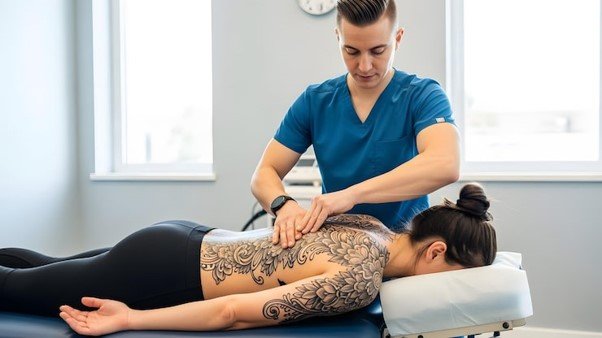
Chiropractic adjustments address these hypomobile segments through high-velocity, low-amplitude thrusts applied to specific joint complexes. The adjustment restores motion to the restricted segment while stimulating mechanoreceptors that provide proprioceptive input to the nervous system. This improved afferent input helps normalize motor control patterns, reducing the compensatory muscle tension often founds in the erector spinae and paravertebral muscles.
Beyond adjustments, soft tissue therapy addresses the myofascial component of postural dysfunction treatment. Techniques including myofascial release, trigger point therapy, and instrument-assisted soft tissue mobilization reduce tension in adaptively shortened muscles like the pectoralis minor and iliopsoas. This integrated approach adjustments for joint restriction plus soft tissue work for muscular dysfunction produces more comprehensive outcomes than either intervention alone.
Patients often report immediate improvements in range of motion and decreased muscle tension following adjustment, with cumulative benefits building over subsequent visits. The frequency and duration of care depends on individual presentation, chronicity, and treatment goals. Those interested in spinal decompression and mobility improvements can discuss whether chiropractic care fits their specific situation.
Key Takeaways: Building a Sustainable Desk Posture Routine
Improving desk posture isn’t a one-time fix but rather the adoption of sustainable habits that support spinal health throughout your working life. The research is clear: interventions that combine ergonomic optimization, targeted exercise, and professional care produce significantly better outcomes than any single approach alone. Consistency matters more than intensity brief, frequent corrections outperform occasional “posture marathons.”
- Optimize your workstation using the 20-degree visual declination rule for monitors and 90-110 degree hip flexion for seating to minimize mechanical stress.
- Implement movement microbreaks every 45-60 minutes with thoracic extension exercises, Brugger’s position, and cervical retractions.
- Strengthen postural stabilizers through regular corrective exercise targeting deep neck flexors, lower trapezius, and core musculature.
- Address joint restriction through chiropractic adjustments when hypomobility persists despite active interventions, restoring proper segmental motion.
- Monitor progress objectively through periodic reassessment of posture, range of motion, and symptom frequency to ensure continued improvement.
For those seeking comprehensive support, holistic lower back healing approaches integrate these elements into personalized treatment plans that address each patient’s unique presentation and goals.
FAQ: Desk Posture Improvement Questions
How long does it take to correct desk-related posture problems?
Timeline varies by individual factors. Most patients notice symptomatic improvement within 2-4 weeks of consistent intervention, with structural changes typically requiring 8-12 weeks of sustained effort. Chronic postural dysfunction that has developed over years generally takes longer to correct than acute issues, and combining chiropractic care with consistent home exercise accelerates outcomes compared to either approach alone.
Can I fix my posture without professional treatment?
Yes, mild dysfunction often responds to self-directed intervention. Studies show that ergonomic modifications and regular exercise can reduce mild to moderate symptoms by approximately 40-50% in motivated individuals. However, joint restrictions and myofascial adhesions often require manual intervention to fully resolve, and professional guidance ensures exercises target your specific dysfunction rather than generic recommendations.
What’s the best chair for preventing office worker back pain?
No single chair works universally for all body types. The optimal chair offers adjustable lumbar support height, seat depth, armrest positioning, and recline tension to accommodate individual anthropometrics. More important than the specific chair is proper adjustment many expensive ergonomic chairs provide no benefit when left in default settings.
How often should I take breaks from sitting?
Every 45-60 minutes is optimal based on current research. Research on tissue creep indicates that ligamentous deformation begins occurring within 20 minutes of sustained positioning, with significant changes by 60 minutes. Brief standing or movement breaks lasting just 60-90 seconds effectively reset tissue length and restore disc hydration, preventing cumulative stress accumulation.
Will a standing desk solve my posture problems?
Standing desks help but aren’t a complete solution. While standing eliminates the hip flexion and posterior pelvic tilt inherent in sitting, prolonged standing creates its own problems including venous stasis and lumbar extension overload. The optimal approach involves frequent position changes alternating between sitting and standing every 30-60 minutes rather than replacing one static posture with another.
Should I see a chiropractor for forward head posture fix?
Yes, chiropractic care effectively addresses forward head carriage. Cervical adjustment restores motion to restricted facet joints while reducing posterior cervical muscle tension, creating the structural foundation for postural correction. Combined with anterior cervical translation exercises that strengthen deep neck flexors, this approach addresses both the joint restriction and muscular imbalance contributing to forward head posture.