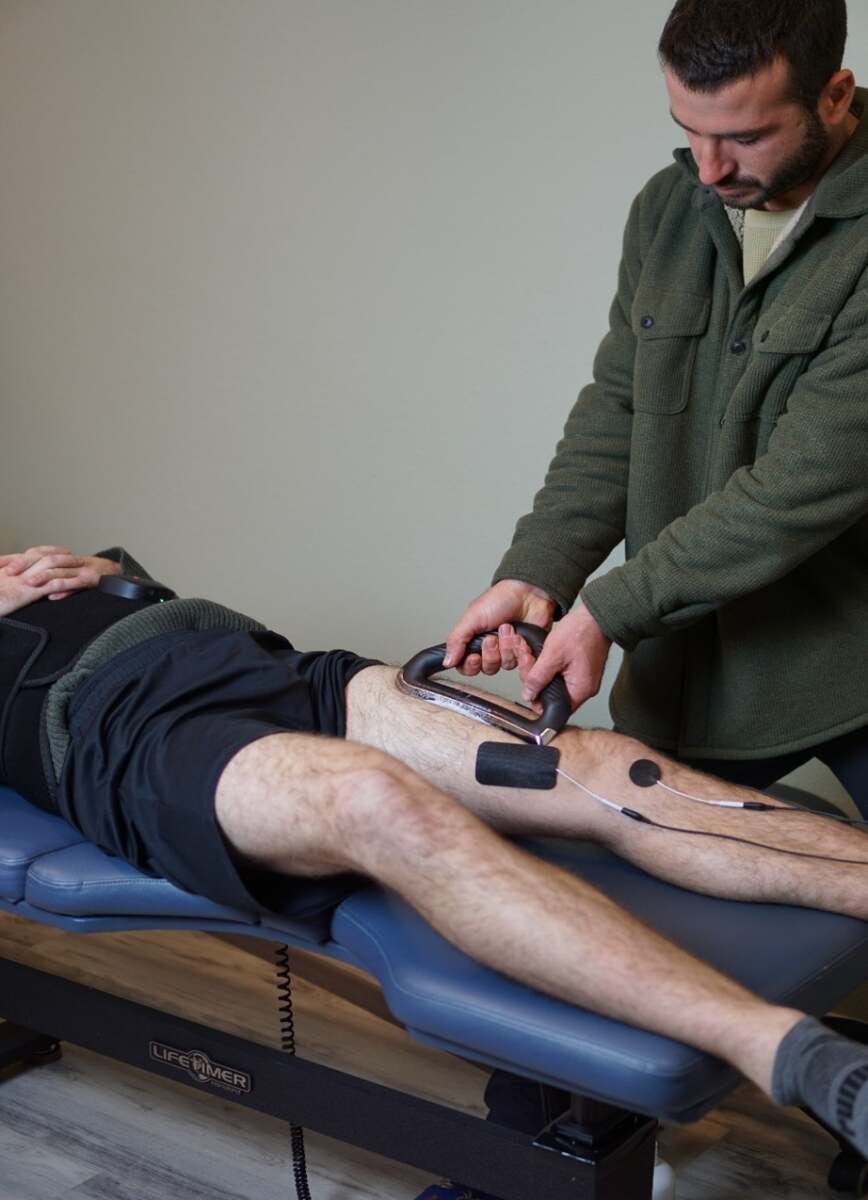
IASTM (instrument-assisted soft tissue mobilization), often called muscle scraping, uses a smooth, beveled steel tool glided over the skin to treat tight, irritated, or scarred soft tissue. It’s most useful for tendon problems, stubborn muscle tightness, and post-injury stiffness, and works best when it’s paired with movement and strengthening rather than used on its own.
Below you’ll find what IASTM actually does, which problems it helps, what a session feels like, what the research says, and when it isn’t the right choice.
What Is IASTM and How Is It Different From Massage?
IASTM is a hands-on soft tissue technique where the clinician uses a rigid instrument instead of only fingers and palms. You may have heard brand names like Graston, but the principle is the same across tools: a contoured edge lets the clinician apply precise, controlled pressure along a muscle, tendon, or fascia.
The instrument does two things a hand can’t do as well. First, it acts like a magnifier. As the edge passes over tissue, the clinician feels small changes in texture, such as thickened, gritty, or restricted areas, that are easy to miss by hand. Second, it lets the clinician treat a narrow, specific spot, like the attachment of a tendon, without a lot of force.
Massage is generally broader and aimed at relaxation and circulation across a whole region. IASTM is targeted, usually shorter, and always followed by movement so the change in tissue carries over into how you actually use the area.
What Conditions Does Muscle Scraping Help?
IASTM is a tool, not a diagnosis-specific cure, so it’s used when soft tissue is part of the problem. The best fits tend to be:
- Tendinopathies: tennis and golfer’s elbow, Achilles tendinopathy, patellar tendinopathy (jumper’s knee), and some rotator cuff tendon irritation. Stubborn cases often respond better when IASTM is combined with focused shockwave therapy.
- Plantar fascia pain: heel and arch pain, often combined with calf work and loading exercises. See how shockwave helps sports and tendon injuries.
- Post-injury stiffness and scar tissue: after ankle sprains, muscle strains, or once a surgical scar has fully healed and your surgeon has cleared you.
- Chronic muscle tightness and trigger points: upper traps, forearms from mouse and keyboard work, calves and hamstrings in runners.
- Limited range of motion: a shoulder that won’t rotate fully, or a hip that feels “stuck” in a squat.
It’s less useful when the main driver is a nerve problem, an inflamed joint, or a structural issue like a large disc herniation. In those cases, soft tissue work may support care, but it won’t be the main fix.
What Does the Research Say?
The research is encouraging but still developing. A 2019 systematic review in the Journal of Athletic Training found that IASTM produced short-term range-of-motion gains in the shoulder and appeared most helpful for function in tendon problems, including elbow, patellar, and Achilles tendinopathy. The authors rated the overall evidence as moderate quality and called for better studies.
A separate 2019 review in the Journal of Contemporary Chiropractic found that patients often had meaningful pain reductions after IASTM, but those reductions weren’t clearly better than the comparison treatments, such as other manual therapy or exercise.
The honest takeaway: IASTM can help, especially for tendons and short-term mobility, but it isn’t magic and it shouldn’t be your whole plan. It earns its place as one piece of a program that also includes loading, movement retraining, and time.
What Does an IASTM Session Feel Like?
Most people describe it as a firm, scraping pressure, a little like a deep massage with a defined edge. Here’s what typically happens:
- Assessment first. We test how the area moves and what reproduces your pain, so we have a baseline to compare against.
- A light lubricant is applied so the tool glides smoothly across the skin.
- Scanning strokes with light pressure to find restricted or sensitive spots.
- Targeted treatment on those spots for roughly 30 seconds to a few minutes each, often while you move the joint through its range.
- Re-test and move. We check the same motion again, then give you rehab exercises to lock in the change.
It shouldn’t be sharply painful. Mild discomfort in a tight area is normal, and pressure is always adjusted to your tolerance. Afterward, the skin may look pink or show small red dots (petechiae) for a day or two, and some people feel mild soreness similar to the day after a workout. Bruising is uncommon with a moderate approach and is not the goal.
Who Should Avoid Muscle Scraping?
IASTM isn’t appropriate for everyone. We skip it or modify it if you have:
- Open wounds, active skin infections, or unhealed surgical incisions over the area
- Blood-clotting disorders, or you take blood thinners (ask first; we may use very light pressure or a different technique)
- Known or suspected deep vein thrombosis
- Fragile skin, varicose veins in the treatment area, or recent steroid injections there
- Active cancer in the area, or a fracture that hasn’t healed
How We Use IASTM at The ChiropractOrr
At The ChiropractOrr, IASTM is rarely a standalone treatment. Dr. Orr uses it inside the same three-step approach that guides every visit: Offload the irritated tissue, Rebuild strength and stability, and Reeducate how you move so the problem doesn’t keep coming back.
In practice, that means a session might combine instrument work on a sore Achilles with an adjustment to the ankle and foot, then calf-loading exercises you’ll do at home. For desk workers with forearm or neck tightness, it’s often paired with FAKTR functional soft tissue work, where we treat the tissue while you move (our complete FAKTR guide explains how it works). You can read more about our specialized soft tissue therapy, or see how it compares to other options in our guide to when soft tissue therapy is recommended.
Visits are available in our Campbell clinic, or we can bring treatment to you with a mobile house-call visit if getting to the office is difficult.
When to See a Doctor First
Get medical attention before any soft tissue treatment if you notice:
- Sudden calf swelling, warmth, or redness, which can signal a blood clot
- A pop at the time of injury followed by weakness, which may mean a tendon rupture
- Numbness, tingling, or weakness spreading down an arm or leg
- Fever, unexplained weight loss, or pain that’s worse at night and doesn’t change with position
- Pain after a fall or accident that could involve a fracture
Key Takeaways
- IASTM uses a smooth steel tool to find and treat restricted soft tissue with precise pressure.
- It fits best for tendon pain, plantar fascia pain, post-injury stiffness, and chronic muscle tightness.
- Research shows short-term mobility gains and benefits for tendinopathy, but it works best alongside exercise.
- Mild redness and soreness are normal; sharp pain and heavy bruising are not the goal.
- Skip it over open wounds, clots, unhealed fractures, or without guidance if you take blood thinners.
FAQ
Is muscle scraping the same as Graston?
Graston is one brand of instrument and training method within the broader category of IASTM. Different tools and brands vary in shape and protocol, but they share the same principle: a rigid edge used to assess and treat soft tissue.
Does IASTM hurt?
It can feel intense over tight or sensitive areas, but it shouldn’t be sharply painful. Pressure is adjusted to your comfort, and most people describe it as a strong, scraping massage.
How many IASTM sessions will I need?
It depends on the problem and how long you’ve had it. Many people notice a change in mobility after the first session, and tendon issues usually need several weeks of combined treatment and exercise to improve meaningfully.
Is it normal to have red marks after muscle scraping?
Yes, temporary redness or small red dots are common and usually fade within one to two days. Large or painful bruises aren’t necessary for results, so let your clinician know if you bruise easily.
Can I exercise after an IASTM session?
Usually, yes. Gentle movement and the exercises you’re given are encouraged right after treatment. If the area feels sore, keep that day’s activity light and resume normal training the next day.
If a tendon, tight muscle, or old injury keeps limiting how you move, IASTM may be a useful part of your plan. Book your initial evaluation or call (408) 641-0739. Can’t make it to Campbell? Ask about a mobile visit.
Written by Dr. Orr Soffer, DC, chiropractor at The ChiropractOrr in Campbell, CA. This article is educational and not a substitute for an individual medical evaluation.